Chiang Mai International Schools 2026: A Parent’s Simple Guide to Choosing the Right School
Introduction
Moving your family to Chiang Mai? You’re joining thousands of expat families who’ve discovered this northern Thai city offers something rare: quality international education without the stress and costs of Bangkok, Singapore, or Western hubs. Currently, In 2026, Chiang Mai has 12+ accredited international schools serving 4,500-5,200 students, with choices spanning British, American, IB, and bilingual curricula.
But “best” depends entirely on your child’s needs, your budget, and your family’s lifestyle. This guide cuts through marketing noise to give you a clear, practical roadmap through understanding your options through enrollment day.
Why Chiang Mai Makes Sense for Families
Cost Advantage: A comfortable 3-bedroom home costs THB 25,000-50,000/month (USD $700-1,400), a fraction of Singapore or Sydney. This leaves more budget for school fees and enrichment activities.
Lifestyle: Mountain valleys, weekend markets, temples, and waterfalls replace urban congestion. Traffic is manageable. Nature is 15-30 minutes away.
Community: Active expat parent networks (12,000+ members on Facebook groups), school-hosted family events, and newcomer support make relocation smoother.
One Caveat: Burning season (February-April) brings poor air quality (AQI 150-300+). Schools adapt with indoor activities and air purifiers. Many families plan to travel during this window.
The School Landscape: Your Main Options
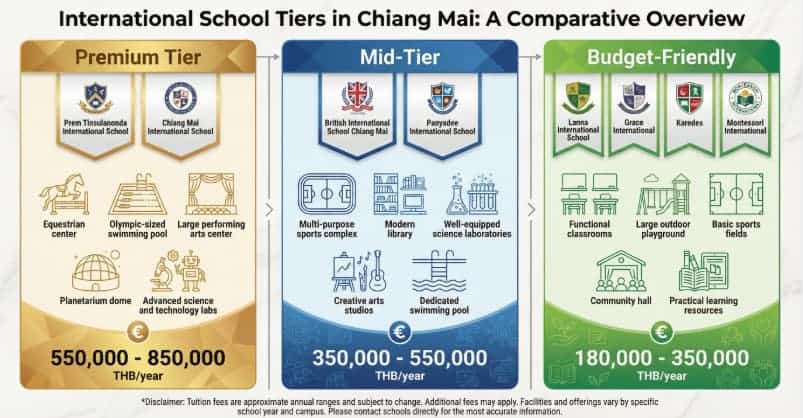
Chiang Mai schools fall into three broad categories:
Premium Tier (THB 550,000-850,000/year)
Prem Tinsulanonda International School
- Curriculum: IB Continuum (ages 3-18)
- Accreditation: CIS, IB
- Highlights: Boarding available (Grades 7-12), highest university placement rates, expansive campus
- Best for: Families targeting global universities, those needing boarding
Chiang Mai International School (CMIS)
- Curriculum: American (AP options)
- Accreditation: CIS, WASC
- Highlights: Established 1963, strong extracurriculars, large expat community
- Best for: US university targets, families valuing tradition and networks
Mid-Tier (THB 350,000-550,000/year)
British International School Chiang Mai (BISC)
- Curriculum: British (IGCSE/A-Levels)
- Accreditation: British Council, CIS
- Highlights: Traditional British structure, strong UK university pathways
- Best for: UK university targets, families preferring structured assessment
Panyadee International School
- Curriculum: IB + Bilingual track
- Accreditation: CIS, IB
- Highlights: Dual-track options, strong Asian university placements
- Best for: Families wanting Thai integration, flexible university pathways
Budget-Friendly (THB 180,000-350,000/year)
Lanna International School
- Curriculum: British + Bilingual
- Accreditation: British Council
- Highlights: Value-focused, community culture
- Best for: Budget-conscious families, Thai cultural exposure
Grace International, Karedes, Montessori International
- Smaller campuses, specialized approaches (faith-based, Montessori early years)
- Best for: Specific educational philosophies, tighter budgets
How to Choose: 5 Questions That Matter
1. Where Will Your Child Go to University?
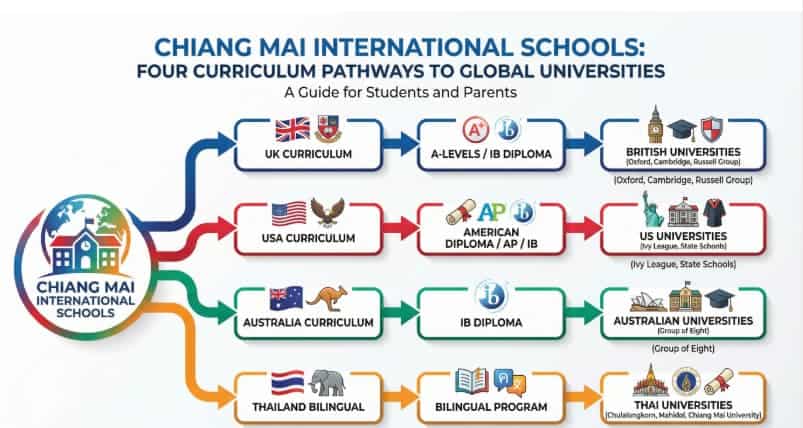
Match curriculum to destination:
- UK → British (A-Levels) or IB
- US → American (AP) or IB
- Australia/Global → IB (easiest transfer)
- Thailand/ASEAN → Bilingual or any international
Why it matters: Switching curricula mid-schooling creates gaps. Choose once and stick with it if possible.
2. What’s Your Real Budget?
Tuition is only part of the cost. Here’s what Year 1 actually looks like:
| Cost Item | Premium Schools | Mid-Tier | Budget |
| Base Tuition (Grades 9-12) | 550,000-850,000 | 350,000-550,000 | 180,000-350,000 |
| Enrollment Fee (one-time) | 80,000-200,000 | 50,000-100,000 | 20,000-50,000 |
| Capital Levy (one-time) | 100,000-200,000 | 50,000-100,000 | 0-50,000 |
| Uniforms, Books, Meals | 60,000-100,000 | 45,000-80,000 | 25,000-50,000 |
| School Bus | 45,000-80,000 | 35,000-60,000 | 20,000-40,000 |
| Total Year 1 | 835,000-1,330,000 | 530,000-890,000 | 245,000-590,000 |
Plan for: 5-6% annual tuition increases. Enquire about sibling discounts (10-15% common) and early-payment incentives.
3. Does Your Child Need Language Support?
If English isn’t your child’s first language, ask:
- Is EAL (English as Additional Language) available?
- What’s the cost? (THB 40,000-120,000/year typically)
- How long until mainstream integration? (Usually 1-3 years)
Red flag: Schools that can’t clearly explain their EAL program structure.
4. What’s the Daily Logistics Reality?
Commute: Most families live in Nimman, Hang Dong, or Mae Rim. Match housing to school catchment. Bus service costs THB 35,000-80,000/year and covers main areas.
After-School Care: Essential if both parents work. Most schools offer care until 5-6pm (THB 5,000-15,000/month). Holiday programs cost THB 8,000-25,000/week.
Class Sizes: Premium schools average 8-12 students per teacher. Mid-tier runs 12-15:1. Some reach 20:1. Smaller isn’t always better, but under 18:1 is ideal for younger children.
5. What Do Other Parents Say?
Visit parent Facebook groups and ask:
- How responsive is administration?
- How are fee increases communicated?
- How did the school handle challenges (burning season, pandemic, etc.)?
Pattern over outliers: One complaint matters less than repeated concerns.
The Application Process: Step by Step
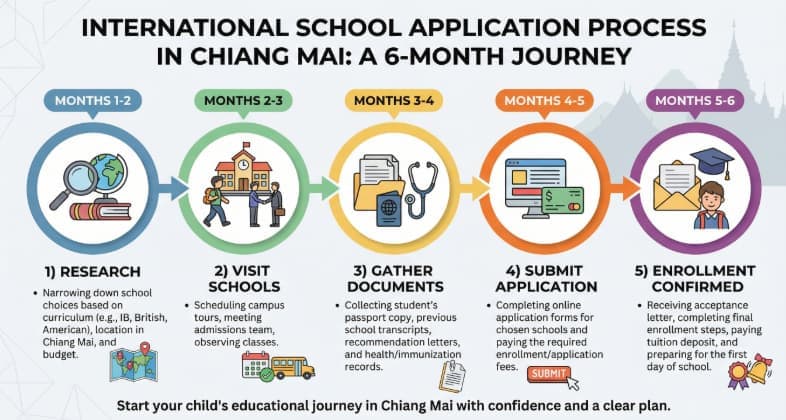
Phase 1: Research (2-4 weeks before applying)
- List your non-negotiables (curriculum, budget, location, special needs)
- Create a simple spreadsheet comparing 5-7 schools
- Check accreditation (CIS, WASC, British Council = internationally recognized)
Phase 2: Shortlist (1-2 weeks)
- Narrow to 3-5 schools meeting your top priorities
- Read inspection reports and parent reviews
- Book campus visits
Phase 3: Visit and Assess (2-6 weeks)
Bring these questions:
- How do you support students transitioning between grade levels?
- What’s your teacher turnover rate? (High turnover disrupts learning)
- How do you handle bullying and mental health concerns?
- Can I see sample student reports?
- What are recent university destinations for graduates?
- What’s included in tuition vs. extra costs?
Observe: Classroom engagement, teacher-student interactions, facility condition.
Phase 4: Apply (Timeline varies by grade)
- Grades 6-12: Apply 9-12 months ahead (competitive entry points)
- Early Years: 3-6 months may suffice
- Documents needed: Passport, visa, birth certificate, previous school reports, vaccination records, teacher references
Interview tips: Prepare your child with simple introductions. For younger kids, schools assess social readiness, not academics. Be transparent about learning support needs.
Conclusion
Choosing between Chiang Mai’s various international schools ultimately comes down to finding the right balance between academic direction, lifestyle, and your child’s individual needs. While Chiang Mai offers strong options across all price points and curricula, the most successful outcomes come from prioritizing fit over prestige, making decisions based on real evidence, and planning well in advance to secure placement in the right environment.
At Panyaden International School, we believe that families exploring Chiang Mai’s international schools should look beyond academics alone. Our approach combines internationally recognized education with mindfulness, sustainability, and values-based development, creating a learning environment where children grow with confidence, emotional intelligence, and a strong sense of purpose, preparing them not just for university, but for life.
Frequently Asked Questions
When is the best time to apply for an international school in Chiang Mai?
Most schools follow an August or September academic year. For Grades 6–12, it’s best to apply 9–12 months in advance, as spaces are limited. Early years programs tend to offer more flexibility.
Can international school fees in Chiang Mai be negotiated?
Top schools typically do not offer discounts on tuition. However, you can ask about sibling discounts, installment payment plans, or early-payment incentives which may offer small savings.
What if my child needs academic support in their International School?
It’s important to disclose any learning needs during the application process. Larger schools usually provide structured support programs, while smaller schools may have more limited resources.
How can I verify if an International school in Chiang Mai is properly accredited?
You can check accreditation directly through organizations such as CIS, WASC, or the British Council. Thai Ministry approval is required but does not guarantee international recognition.
How does the burning season affect schooling?
From February to April, air quality can be poor. Schools typically adapt by limiting outdoor activities and using air purification systems. Some families choose to travel during this period.
Are scholarships available in Chiang Mai international schools?
Yes, some schools offer merit-based scholarships with partial tuition coverage. Availability and criteria vary, so it’s best to inquire during the admissions process.
Can we visit schools before making a decision?
Yes. Most schools offer campus tours, trial days, or introductory sessions. Visiting in person is one of the most effective ways to evaluate whether a school is the right fit.
What is required for a student visa?
Schools usually assist with the process. You will need enrollment confirmation, passport documentation, and proof of financial support.